
An RCD (Residual Current Device) is a vital safety component in your home’s electrical system, designed to protect you and your family from serious electric shocks and reduce the risk of electrical fires. When your RCD trips, it means it’s detected a potential danger and has cut off the power to prevent harm.
EXTREME ELECTRICAL HAZARD WARNING: Working with electricity can cause severe injury or death. NEVER attempt complex electrical repairs yourself unless you are a qualified and certified electrician. The information in this guide suggests only the safest, most basic troubleshooting steps that do not involve opening electrical panels, switches, or working directly with live wires. If you are unsure, if a problem persists, or if you suspect a serious electrical fault, turn off the power at your consumer unit (fuse box) and call a qualified electrician immediately.
What is an RCD?
An RCD is a highly sensitive safety device found in your consumer unit (fuse box). It constantly monitors the flow of electricity in a circuit.
In a healthy circuit, the electricity flowing out through the live wire should exactly equal the electricity flowing back through the neutral wire. An RCD detects even a tiny imbalance (a “residual current” or “earth leakage”). This imbalance indicates that electricity is escaping the circuit, possibly through an unintended path – like through a person who has accidentally touched a live wire, or through damaged insulation to the earth.
If an RCD detects this imbalance, it trips almost instantaneously (typically within milliseconds), cutting off the power to that circuit. This rapid response is what can prevent fatal electric shocks and mitigate fire hazards.
Fixed RCDs: Installed in your consumer unit and protect individual circuits or groups of circuits. These offer the highest level of protection.
Socket-Outlet RCDs: Built into a special socket. They protect only the person using an appliance plugged into that specific socket.
Portable RCDs: Plug into a standard socket, and then an appliance plugs into the RCD. Used for temporary protection, often for outdoor tools.
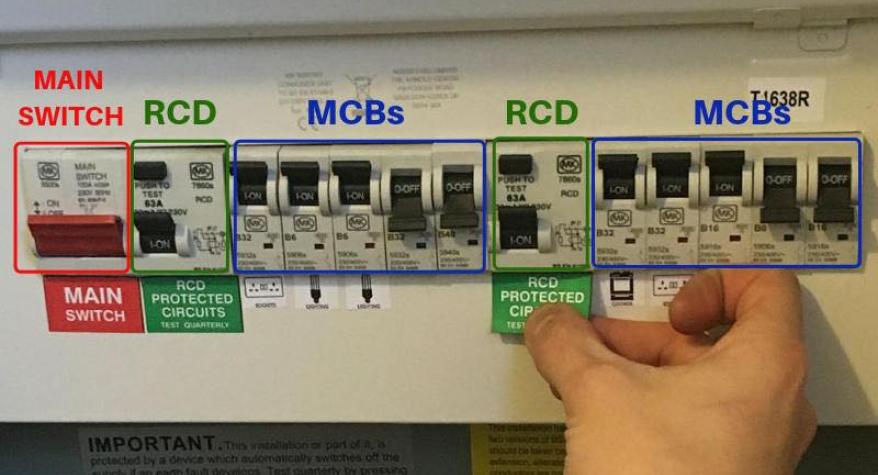
You can usually identify an RCD in your consumer unit by a large switch or button often marked “Test” or “T”. You should regularly test your RCDs (e.g., quarterly) by pressing this button to ensure they are working.
Why Does an RCD Trip? (Common Causes)
An RCD trips because it’s doing its job – protecting you from danger. The key is to find why it detected a fault.
Description: This is one of the most common reasons. An internal fault within an appliance (e.g., kettle, washing machine, hairdryer, toaster, fridge/freezer) can cause a small amount of electricity to leak to earth. This imbalance triggers the RCD.
Symptom: The RCD trips immediately when you plug in or switch on a specific appliance.
Description: Worn, frayed, chewed (by rodents), or improperly installed wiring can have damaged insulation, allowing current to leak to the earth. This can happen behind walls, in lofts, or in crawl spaces.
Symptom: RCD trips randomly, or when specific lights/outlets are used, or after recent DIY work (e.g., drilling into a wall).
Description: Water is an excellent conductor of electricity. If water gets into electrical sockets (especially outdoor ones), light fixtures, junction boxes, or even inside appliances, it can create an earth leakage path.
Symptom: RCD trips during or after rain, if a pipe leaks, or if an appliance used in a damp area (like a bathroom) is the culprit.
Description: While circuit breakers (MCBs) primarily protect against overloads, severe overloads or specific types of current draw can sometimes cause an RCD to trip, especially if combined with minor leakage.
Symptom: RCD trips when many high-power appliances are used simultaneously on the same circuit.
Description: Less common, but RCDs can degrade over time, becoming overly sensitive (“nuisance tripping”) or failing to function correctly.
Symptom: RCD trips frequently without any clear cause, even after you’ve eliminated all other possibilities, or it fails the “Test” button function.
Safe Troubleshooting Steps You Can Perform When an RCD Trips:
The goal is to isolate the faulty circuit or appliance.
Before doing anything, ensure your hands are dry.
Go to your consumer unit (fuse box).
Locate the tripped RCD (it will be in the ‘off’ or ‘down’ position, or sometimes a middle position).
Push the RCD lever fully to the ‘off’ position, then firmly push it back to the ‘on’ (up) position.
If it immediately trips again: This indicates a serious, constant fault. Proceed to step 3.
If it stays on: The trip might have been a momentary fluctuation or a minor, transient issue. Observe if it trips again.
Turn off all circuit breakers (MCBs) that are protected by the RCD that keeps tripping. (These are usually the smaller switches next to or below the RCD). All these individual switches should now be in the ‘off’ position.
Now, try to reset the RCD again. If it stays on, the fault is on one of the circuits you just turned off.
Keep the RCD on, then turn on each individual circuit breaker (MCB) one by one.
As soon as the RCD trips again, you have identified the specific circuit that has the fault.
Leave that particular circuit breaker off.
You can now turn on the rest of the circuit breakers to restore power to most of your home, while the faulty circuit remains isolated.
Once you’ve identified the faulty circuit (from step 3, or if the RCD only trips when you use a specific room/area):
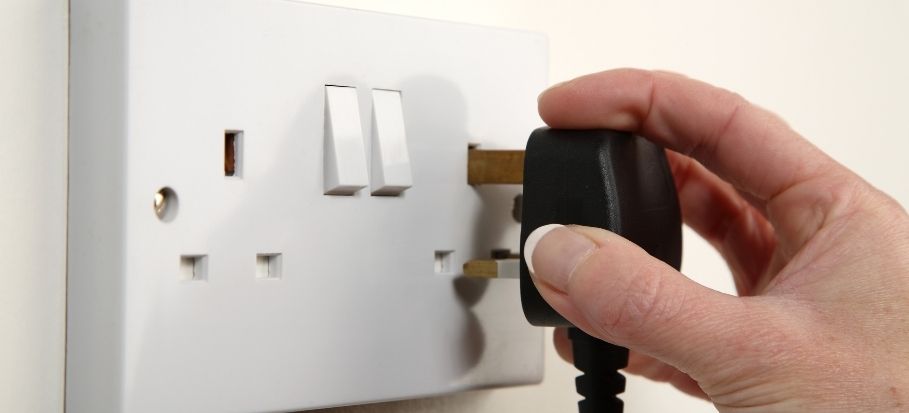
Unplug ALL appliances from every socket on that faulty circuit. Don’t forget fridges, freezers, washing machines, dishwashers, outdoor lights, pond pumps, and appliances plugged in behind furniture. For lighting circuits, try turning off all light switches.
Go back to the consumer unit and try to reset the circuit breaker for that circuit, and then the RCD (if it’s a main RCD).
If the RCD now stays on: The fault is with one of the appliances you unplugged.
Now, plug in and switch on each appliance one by one on that circuit.
As soon as the RCD trips again, you’ve found the faulty appliance. Unplug it and do not use it again until it’s been professionally repaired or replaced.
If the RCD still trips even with all appliances unplugged/switched off on that circuit: The fault is likely in the fixed wiring of that circuit (e.g., cables in walls, light fixtures, or hidden junction boxes).
When to Call FE Maintenance (A Qualified Electrician):
Never ignore an RCD trip. It’s a critical safety warning. A qualified electrician from FE Maintenance has the necessary test equipment to safely diagnose and repair the exact cause of RCD tripping.
Don’t risk your safety. Call FE Maintenance today for expert electrical fault diagnosis and repair: [Your Phone Number] or [Link to Contact Page].